


Description
SparkFun MyoWare 2.0 Muscle Sensor – Arduino-Compatible EMG Sensor
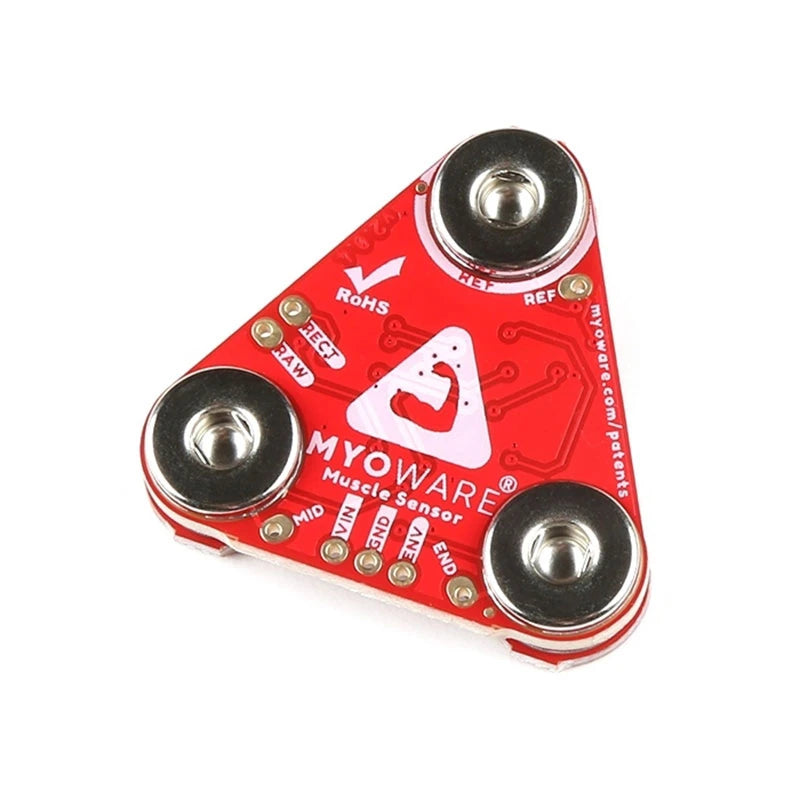
The SparkFun MyoWare 2.0 Muscle Sensor (DEV-27924) is a compact, wearable electromyography (EMG) sensor designed to detect and measure electrical activity generated during muscle contractions. Developed by Advancer Technologies in collaboration with SparkFun Electronics, this Arduino-compatible muscle sensor enables users to convert muscle activity into analog signals for controlling electronic devices, robotics, prosthetic prototypes, and interactive systems.
Using surface electromyography (sEMG) technology, the MyoWare 2.0 measures electrical signals produced by muscle activation and converts them into a corresponding analog voltage output. Its envelope output represents muscle activation intensity, allowing microcontrollers such as Arduino to interpret muscle flexing and trigger programmed actions.
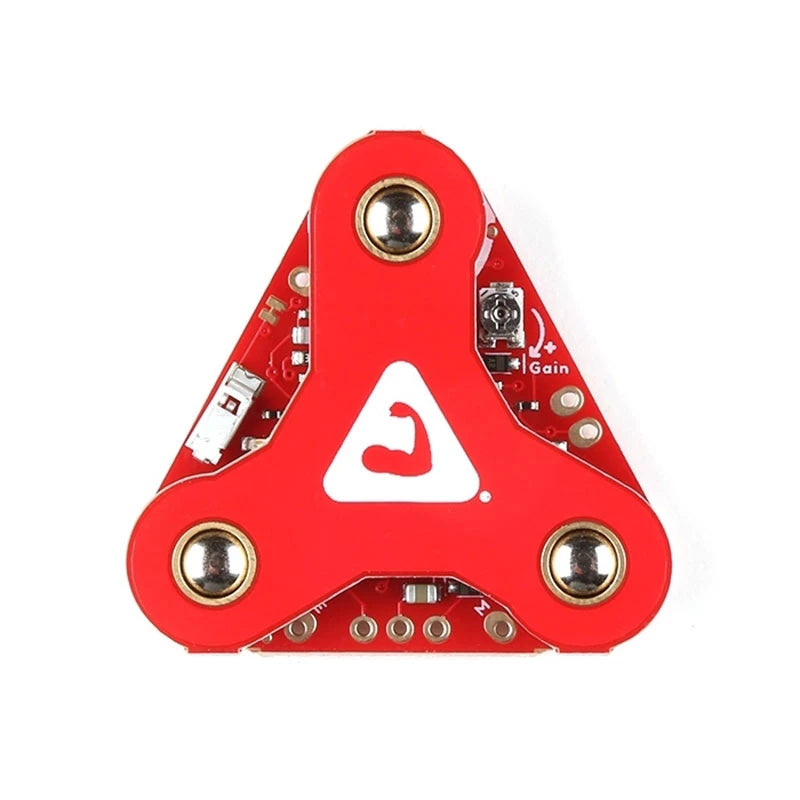
Featuring three EMG output modes—Raw, Rectified, and Envelope, the sensor supports different signal-processing and monitoring applications. Its adjustable gain enables sensitivity customization, while reverse polarity protection helps protect the circuit from incorrect power connections.
The redesigned snap connector system allows compatible biomedical electrode pads and MyoWare 2.0 expansion shields to connect without soldering. With onboard VIN and ENV indicator LEDs, a reference electrode jumper, and compatibility with optional Power, Cable, and LED shields, the MyoWare 2.0 offers a flexible platform for muscle-controlled electronics and educational experimentation.
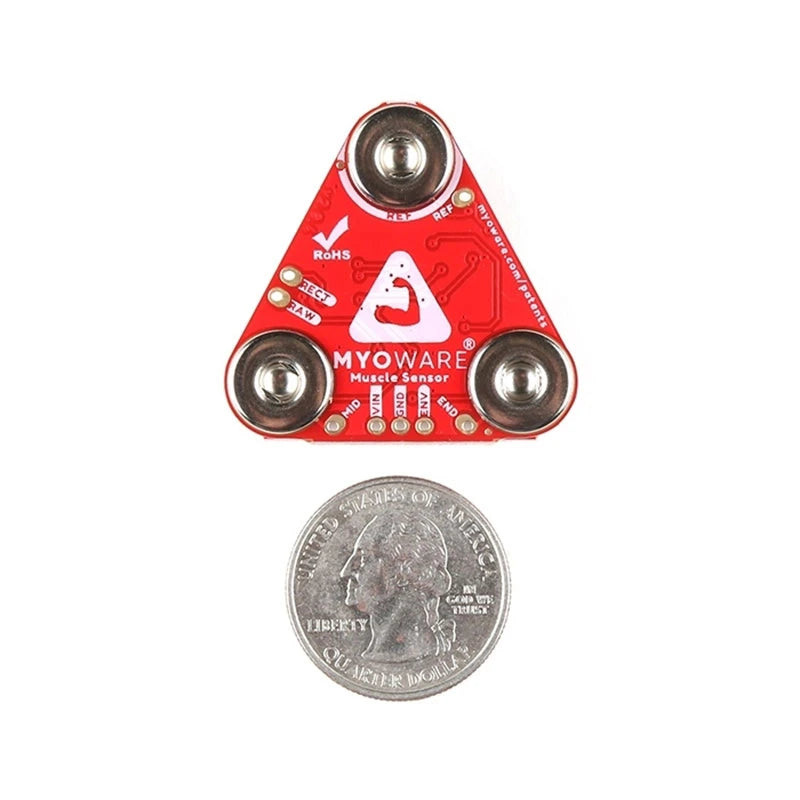
Operating with a typical 3.3V or 5V DC supply and measuring just 37.57 × 35.90mm, this sensor is suitable for wearable electronics, human-machine interfaces, biomechanics demonstrations, and embedded development projects.
Key Features
-
Surface EMG Muscle Detection: Measures electrical activity generated during voluntary muscle contractions.
-
Arduino-Compatible Analog Output: Converts muscle activity into analog voltage signals readable by compatible microcontrollers.
-
Three Signal Output Modes: Supports Raw EMG, Rectified EMG, and Envelope signal outputs.
-
Muscle-Controlled Electronics: Enables interactive applications that respond to muscle activation.
-
Adjustable Signal Gain: Allows sensitivity adjustment for different muscle groups and experimental requirements.
-
Wearable Sensor Design: Compact form factor with integrated electrode snap connectors.
-
Solder-Free Snap Connections: Simplifies connection to compatible biomedical electrode pads and MyoWare expansion shields.
-
3.3V and 5V Operation: Supports common microcontroller power supply voltages.
-
Reverse Polarity Protection: Helps protect the sensor against incorrect supply polarity.
-
Onboard LED Indicators: VIN and ENV LEDs provide power and muscle activity feedback.
-
Reference Electrode Jumper: Supports reference electrode configuration.
-
Expandable MyoWare Ecosystem: Compatible with optional MyoWare 2.0 Power, Cable, LED, and interface shields.
-
Compact Board Design: Measures 37.57 × 35.90mm for wearable and embedded prototypes.
Technical Specifications
| Parameter | Specification |
|---|---|
| Brand | SparkFun |
| Technology Developer | Advancer Technologies |
| Product Name | MyoWare 2.0 Muscle Sensor |
| Manufacturer Part Number | DEV-27924 |
| Product Type | Surface EMG Muscle Sensor |
| Sensing Technology | Surface Electromyography (sEMG) |
| Minimum Supply Voltage | 2.27V DC |
| Typical Supply Voltage | 3.3V / 5V DC |
| Maximum Supply Voltage | 5.47V DC |
| Input Bias Current | 250pA Typical, 1nA Maximum |
| Analog Output Range | 0V to VIN |
| Output Modes | Raw EMG, Rectified EMG, Envelope |
| Rectification Method | Full-Wave |
| Adjustable Gain | Yes |
| Raw Signal Gain | 200 (Ideal) |
| Rectified Signal Gain | 200 (Ideal) |
| High-Pass Filter Cutoff | 20.8Hz |
| Low-Pass Filter Cutoff | 498.4Hz |
| Envelope Filter Cutoff | 3.6Hz |
| Reverse Polarity Protection | Yes |
| Input Electrode Connections | 3 × Female Snap Connectors |
| Power & Output Connections | 3 × Male Snap Connectors |
| LED Indicators | VIN, ENV |
| Reference Electrode Jumper | Yes |
| Interface | Analog Voltage Output |
| Compatible Platforms | Arduino and Other Compatible Microcontrollers |
| Board Dimensions | 37.57 × 35.90mm |
Applications
-
Muscle-Controlled Robotics: Develop robots and electronic systems that respond to muscle activation signals.
-
Prosthetic Prototyping: Experiment with EMG-based control mechanisms for research and educational prosthetic projects.
-
Human-Machine Interfaces: Create alternative input systems controlled by muscle contractions.
-
Wearable Electronics: Build interactive wearable devices using muscle activity as an input signal.
-
Biomechanics Education: Demonstrate electrical muscle activity and basic electromyography concepts.
-
Interactive Gaming: Develop experimental game controllers operated through muscle flexing.
-
Gesture-Controlled Systems: Explore muscle activation patterns for interactive electronic control.
-
Arduino Projects: Monitor analog EMG signals and use them to trigger LEDs, motors, servos, and other components.
-
EMG Signal Processing: Study raw, rectified, and envelope muscle activity signals using suitable acquisition hardware.
Package Contents
-
1 × SparkFun MyoWare 2.0 Muscle Sensor (DEV-27924)
Note: Biomedical electrode pads, cables, Arduino boards, and optional MyoWare expansion shields are sold separately unless specifically included in the supplied package.
Important Safety Information
This sensor is intended for educational, prototyping, and experimental applications. It is not a medical device and must not be used for medical diagnosis, treatment, or clinical monitoring.
Use an appropriate battery-powered or electrically isolated setup when attaching electrodes to the body. Follow the manufacturer's safety instructions and avoid unsafe connections to mains-powered equipment.
Technical Documentation
For installation instructions, electrode placement guidance, wiring diagrams, signal output examples, and Arduino integration, refer to the SparkFun MyoWare 2.0 Muscle Sensor Hookup Guide.