
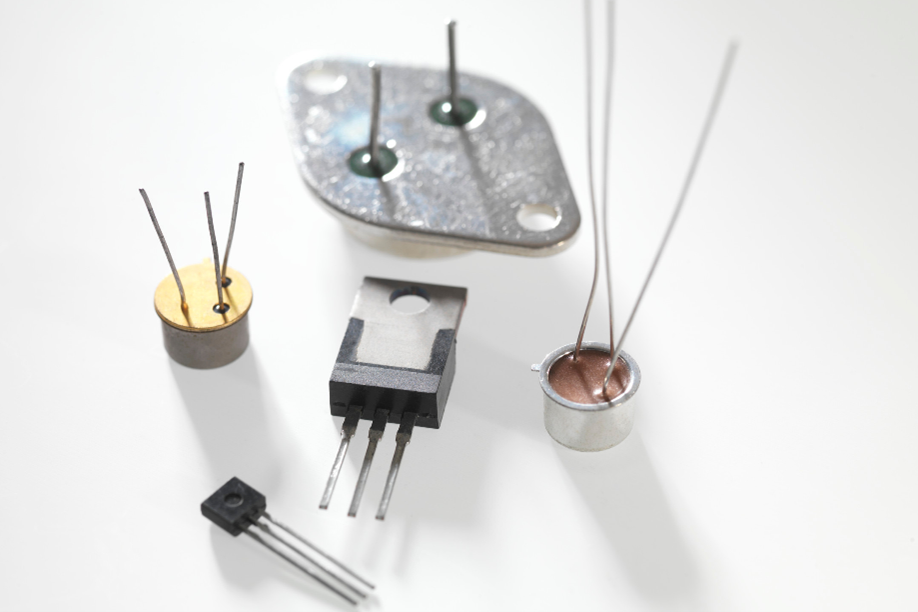
If resistors are the brakes, and capacitors are the power buffers of a circuit… then transistors? They're the real MVPs—the tiny switches and amplifiers that made modern computing possible. Seriously, without them, you wouldn’t have smartphones, laptops, or even this blog.
So let’s give this tiny titan the respect it deserves. Welcome to the world of transistors, where a little current can control a lot of power—and whole revolutions are born from microscopic switches.
What Is a Transistor?
At its core, a transistor is a tiny electronic switch or amplifier made of semiconductor material. It controls the flow of current between two terminals using a third.

The most common types you'll come across:
- BJT (Bipolar Junction Transistor) – controlled by current
- MOSFET (Metal Oxide Semiconductor FET) – controlled by voltage
Each type has three legs (or pins):
For BJTs:
- Base (B) – the control pin
- Collector (C) – where the current flows in
- Emitter (E) – where the current flows out
For MOSFETs:
- Gate (G) – the control pin
- Drain (D) – where current enters
- Source (S) – where the current exits
What Can a Transistor Do?
Transistors are the building blocks of logic, amplification, and switching in electronics. Here’s what makes them awesome:
- Switch Stuff On/Off – Like turning on a motor with a tiny signal
- Amplify Signals – Make a weak mic input strong enough to hear
- Think for Themselves – Logic gates, memory, CPUs… all built from transistors
Basically, if a diode is a traffic cop, a transistor is the powerful manager deciding which lanes open and when.
Real-World Uses
· In Arduino projects, use a transistor to switch high-current devices like fans, motors, or even 12V lights.
· In audio circuits, transistors amplify signals to drive speakers.
· Inside your computer, millions (sometimes billions) of transistors act like tiny on/off switches, performing calculations.
Easy Circuits to Try
LED Controlled by Transistor (NPN BJT)

- Connect an NPN transistor (like a 2N2222 or BC547).
- LED + resistor on the collector side, emitter to GND.
- Apply a small current to the base (via a 3k resistor), and the LED lights up!
What’s happening? A tiny base current turns on a larger collector-emitter current. That’s amplification in action.
Did You Know?

- The first transistor was built in 1947 at Bell Labs—it was huge compared to today’s nanoscale versions.
- A modern CPU contains over 50 billion transistors—yes, billion!
- The word "transistor" is a blend of “transfer” and “resistor.”
- Transistors in microchips are now smaller than some viruses!
Final Thoughts
Transistors are like magic gates that let us control big things with tiny signals. Whether you’re automating a light, building a speaker amp, or dreaming of making your own microcontroller—it all starts with understanding this tiny switch.
So next time you hold a transistor, remember: you're holding the foundation of the digital age.
Try wiring one up today—and who knows, maybe you’re just a few circuits away from inventing the next big thing.